By Trudy Medcalf, PhD
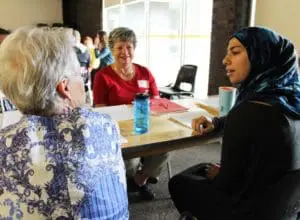
Bill, in his 80s, has arrived at the university from a long-term care home nearby. A stroke survivor, he sits in his wheelchair around a table with another older person and four undergraduate students. My students are taking a summer course in literary gerontology although not all are gerontology students; the older adults have volunteered to work with us this morning. Six small groups are ready to begin our first intergenerational reading circle.
Everyone has had at least a week to prepare – to read and reflect on the same set of readings from novels, short stories, poetry and memoir, excerpts from works by Constance Beresford-Howe, Oliver Sacks, Margaret Atwood, Julian Barnes and others. Both young and old tell me later that they were nervous, wondering how to fill 90 minutes with conversation. Most of my students wonder what they can contribute to a discussion with people who already know so much about growing old. Some of the older participants wonder about how they will be perceived. No one acknowledges misgivings yet.
Both younger and older participants have received preparation for the event, although not much. Designated students are each ready to open their group’s discussion. Time to begin.
Reading circles are small groups of people who love to read and to share ideas. Usually facilitated, groups meet weekly for a number of weeks to discuss sets of readings similar to the ones we’re using today. For several years I’ve facilitated reading circles with older adults, usually in public libraries. I’d never given thought to the idea of an intergenerational reading circle or its possible outcomes. But sometimes the time is right and the idea presents itself.
And the outcome? Consider this small selection from comments written later by the students:
“The intergenerational learning was an amazing experience. I believe that some of the benefits for both the older and younger adults were challenging biases of both and realizing that everyone is just living their lives.”
“All in all, we wished it hadn’t been only 90 minutes; our group heartily agreed we could have gone on all day with each other. It was wonderful to see how much each of us learned from the other.”
“Older adults may be at a different stage in life, yet they are more alike to younger adults than many believe…I was grateful to have had my presumptions about older adults destroyed.”
And from some of the older adult participants:
“I found that talking about questions like, ‘How does this selection connect to me or to others in my life,’ with the students fostered real connection by sharing deeper feelings, ideas and personal concerns.”
“My experience was positive for many reasons. I felt like I can still contribute to society…even in old age.”
“It was fascinating to see the various thoughts of students of different backgrounds.”
“Learning from other seniors also enriched my understanding of the aging journey. We are not alone and can laugh at times at our struggles.”
Waiting outside with Bill for the van that will take him home, I learn that both he and a student at his table, a nursing student as it turns out, found they had highlighted the exact same sentence from Oliver Sacks’ memoir, Gratitude: “I often feel that life is about to begin, only to realize it is almost over.”
Next day, the nursing student tells me that people often ask her why she’s choosing to become a geriatric nurse. Her standard reply has been that she just loves old people, loves to hear their stories. But this time she stops. Her voice changes, her posture shifts. She speaks more slowly, indeed more intensely now. “I will never say that again……I will never again patronize old people……I’m grateful to Bill for this deeper level of understanding.” For me it’s intriguing to see how 90 minutes of focused interaction can foster genuine connection, rich with meaning, between generations who are too often pushed away from each other.
About Trudy Medcalf
Email: [email protected]
Trudy Medcalf, PhD, is a professor in the Gerontology Department at Laurentian University, Sudbury, Ontario. Her doctoral work in education explored the meaning of old age and the experience of growing older, always from the perspective of those living there.
Winner of the Margaret Griffiths Award, Trudy was invited to contribute to the creation of what’s come to be known as Smart Aging, an eight-session educational program designed to “better equip individuals to navigate life’s transitions in their senior years.”
As author and facilitator of four of the modules of the Smart Aging core and elective programs, it’s been Trudy’s joy to have been given the opportunity to shape the Smart Aging program with her long-held beliefs about how older adults learn best.